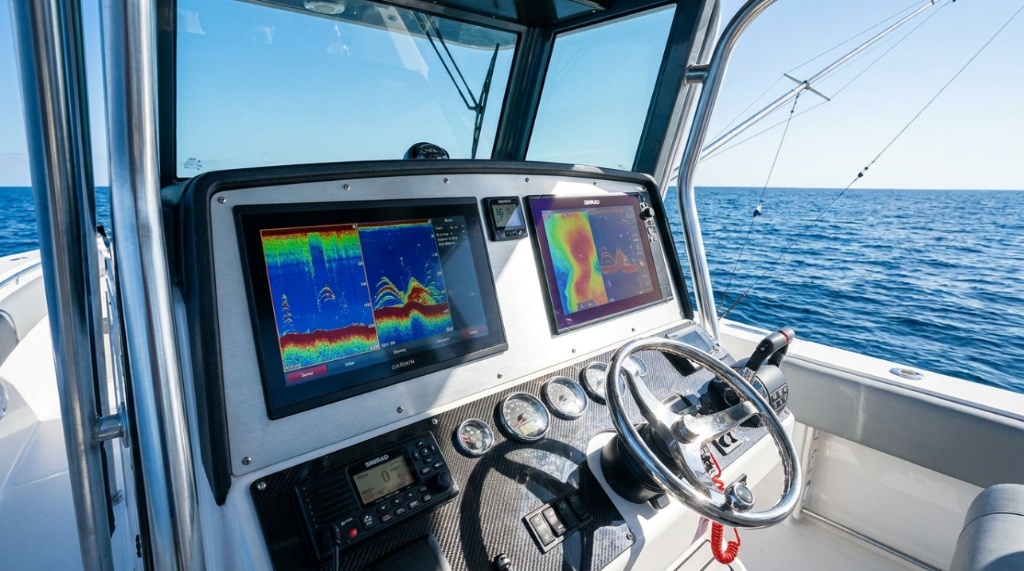
Fishing in Florida’s diverse waters but struggling to find the right fish finder? Florida’s mix of freshwater lakes, brackish estuaries, and deep-sea saltwater demands a versatile fish finder. The wrong device can leave you missing fish, wasting time, and even damaging your gear in saltwater.
Why Is Florida Fishing Different for Fish Finders?
Florida’s warm, shallow, and often brackish waters require fish finders with saltwater compatibility, high-resolution imaging, and adaptability to varying depths. Here’s what makes Florida unique:
- Diverse Water Types: From freshwater lakes to saltwater flats and deep offshore waters, Florida offers a wide range of fishing environments.
- Shallow Waters: Many of Florida’s best fishing spots are in shallow waters (under 20 feet), requiring high-frequency sonar for detailed imaging.
- Saltwater Corrosion: Saltwater can corrode transducers and other components, so saltwater-rated models are a must for coastal fishing.
- Warm Water: Warm water can affect sonar performance, so devices with temperature compensation are ideal.
- Vegetation and Structure: Florida’s waters are full of grass beds, mangroves, and rocky structures, which can interfere with sonar signals.
What Features Should a Florida Fish Finder Have?
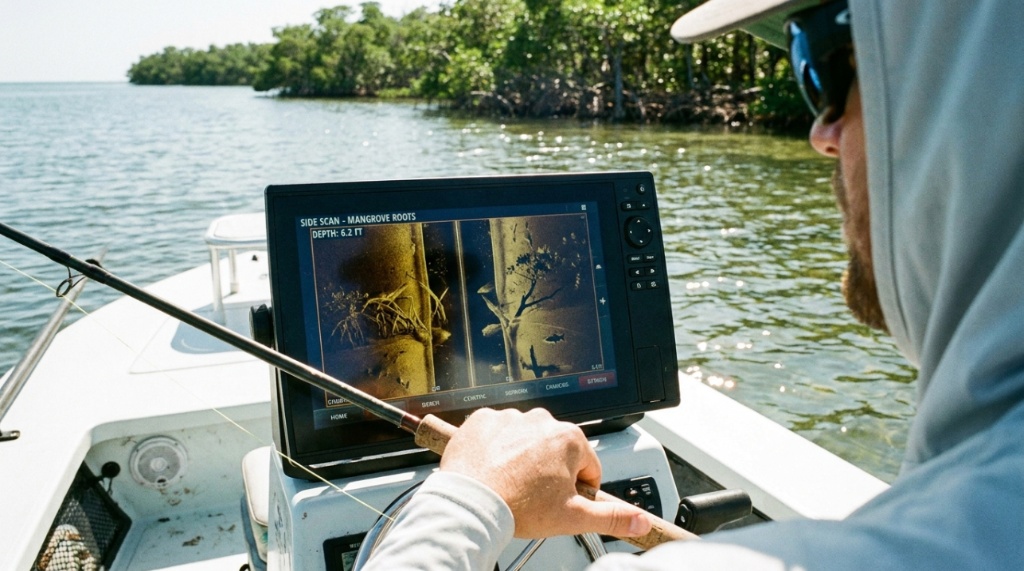
A fish finder for Florida waters should include saltwater compatibility, CHIRP sonar, and high-resolution displays to handle the state’s diverse conditions. Here are the must-have features:
| Feature | Why It Matters | Recommended Specs |
|---|---|---|
| Saltwater Compatibility | Prevents corrosion and ensures accurate readings in saltwater. | Saltwater-rated transducer and housing |
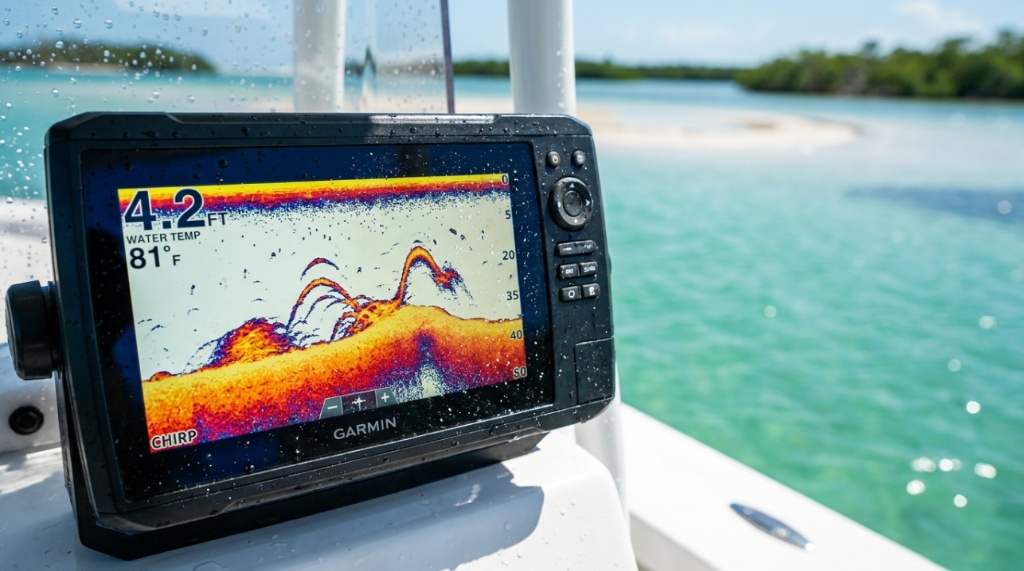
| CHIRP Sonar | Provides clearer images and better fish separation in shallow and deep water. | Dual or triple frequency CHIRP |
| High-Resolution Display | Allows you to see fine details in Florida’s often murky or vegetation-filled waters. | 480×480 pixels or higher |
| Side Imaging/Down Imaging | Helps you locate fish and structure in shallow waters and around vegetation. | Side Imaging: 455/800 kHz; Down Imaging: 455/800 kHz |
| GPS and Mapping | Essential for navigating Florida’s vast and often featureless waters. | Built-in GPS with preloaded maps or compatibility with Navionics |
| Temperature Sensor | Helps you locate fish by identifying temperature changes and thermoclines. | Built-in or external temperature probe |
People also ask: Can I use a freshwater fish finder in Florida’s saltwater?
No. Saltwater will corrode a freshwater-rated transducer and void most warranties. Always choose a saltwater-compatible model for Florida’s coastal waters.
When scouting the shallow flats or mangrove shorelines with your new sonar, targeting the right structure is only half the battle—you also need the right presentation to trigger a strike. If your GPS maps lead you to high-activity zones holding hungry predators, switching to the Best Artificial Shrimp Lures for Redfish can dramatically increase your hook-up rate. Even the most advanced fish finder can only show you where the schools are hiding; pairing that tech with a lifelike, highly effective shrimp imitation ensures that once you find the fish, you actually catch them.
What Are the Best Fish Finders for Florida Waters?
Here are the top fish finders for Florida, based on performance, durability, and user reviews. These models are designed to handle Florida’s unique fishing conditions.
| Model | Type | Max Depth | Frequency | Best For |
|---|---|---|---|---|
| Garmin Striker Plus 7sv | CHIRP + SideVu | 2,300 ft | 50/77/200 kHz | Versatile, freshwater and saltwater |
| Lowrance HOOK Reveal 9 | CHIRP + DownScan | 3,000 ft | 83/200 kHz | Deep water, offshore fishing |
| Humminbird HELIX 7 CHIRP GPS G3 | CHIRP + Side Imaging | 1,500 ft | 455/800 kHz | High-resolution imaging, inshore fishing |
| Raymarine Dragonfly 7 Pro | CHIRP + DownVision | 600 ft | 180/450/800 kHz | Shallow water, flats fishing |
| Deeper PRO+ | Castable, Portable | 260 ft | 290 kHz | Kayak and shore fishing |
For a detailed comparison, check out the best fish finder for Florida to find the perfect model for your needs.
How to Use a Fish Finder in Florida’s Shallow Waters?
In shallow waters, use high-frequency sonar, adjust sensitivity, and focus on structure to locate fish effectively. Here’s how to get the most out of your fish finder in Florida’s flats, lakes, and rivers:
- Use High Frequency: Set your fish finder to 200 kHz or higher for better resolution in shallow water (under 100 feet).
- Adjust Sensitivity: Increase sensitivity to pick up small fish and subtle structures, but reduce it if you’re getting too much clutter from vegetation or the bottom.
- Focus on Structure: Look for drop-offs, grass beds, and rocky areas where fish like to hide. Use Side Imaging or Down Imaging to get a detailed view of these spots.
- Watch for Baitfish: If you see a cloud of small fish on your screen, there’s a good chance larger predatory fish are nearby.
- Use GPS to Mark Spots: When you find a productive area, mark it on your GPS so you can return to it later.
Pro tip: In very shallow water (under 10 feet), try using a flasher-style display, which can make it easier to see fish and structure in real time.
What Are the Common Challenges of Fishing in Florida and How to Overcome Them?
Florida’s fishing conditions present unique challenges, such as vegetation, shallow water, and saltwater corrosion. Here’s how to tackle them:
| Challenge | Solution |
|---|---|
| Vegetation | Use high-frequency sonar and Side Imaging to see through grass beds. Adjust sensitivity to reduce clutter. |
| Shallow Water | Switch to high-frequency sonar (200 kHz or higher) and reduce the depth range to focus on the water column where fish are likely to be. |
| Saltwater Corrosion | Choose a saltwater-rated fish finder and rinse it with freshwater after each use to prevent corrosion. |
| Warm Water | Use a fish finder with temperature compensation to ensure accurate depth readings in warm water. |
| Murky Water | Increase the power output of your fish finder to penetrate murky water and get clearer readings. |
Frequently Asked Questions
Can I use a fish finder in both freshwater and saltwater in Florida?
Only if it’s rated for both. Some fish finders are designed for freshwater and saltwater use, but most are specialized for one or the other. Always check the manufacturer’s specifications.
What’s the best fish finder for Florida’s inshore fishing?
For inshore fishing, a model with CHIRP sonar, Side Imaging, and GPS is ideal. The Humminbird HELIX 7 CHIRP GPS G3 and Raymarine Dragonfly 7 Pro are both excellent choices for Florida’s inshore waters.
How do I protect my fish finder from saltwater damage?
Rinse your fish finder with freshwater after each use in saltwater. This removes salt residue that can cause corrosion. Also, store it in a dry, protected place when not in use.
Do I need a fish finder with GPS for Florida fishing?
It’s highly recommended. Florida’s vast and often featureless waters can be difficult to navigate without GPS. A fish finder with GPS will help you mark productive spots and find your way back safely.
What’s the best depth range for a Florida fish finder?
It depends on where you fish. For shallow inshore waters, a depth range of 300–600 feet is sufficient. For offshore fishing, look for a model that can reach at least 1,000 feet.