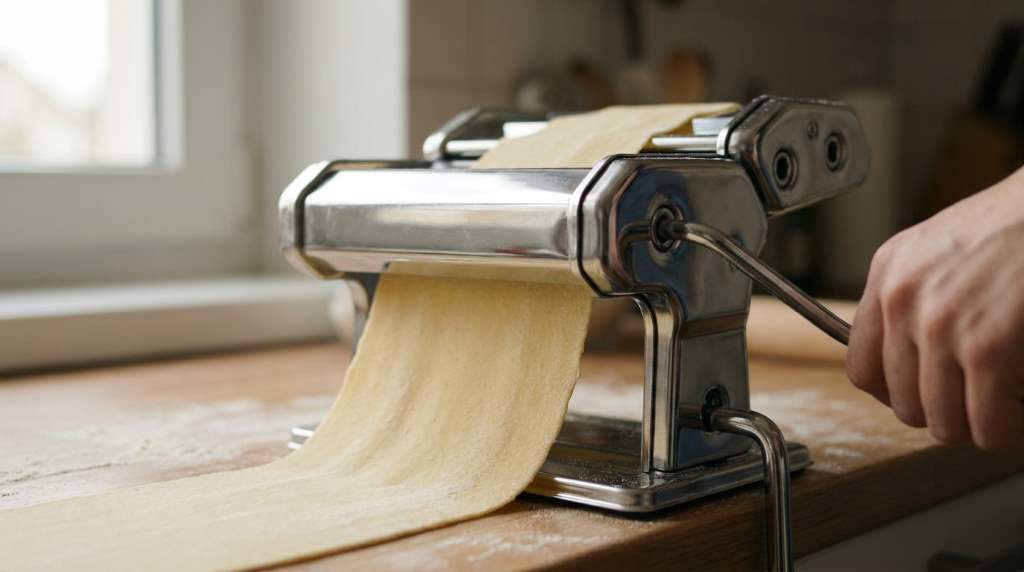
The Sailnovo 2-in-1 Pasta Maker is a manual machine, not an electric pasta maker. It suits hands-on cooks who value control, while electric models win on speed and reduced effort.
The Sailnovo combines nine thickness settings with two cutting widths in one compact countertop tool. For shoppers comparing a hand-crank pasta machine against electric options, that distinction matters. The design saves space, but every sheet still requires physical cranking.
Key Takeaways
- Operation: Sailnovo uses a hand crank and requires no electricity.
- Function: The 2-in-1 design rolls dough and cuts noodles.
- Control: Nine thickness settings provide useful adjustment for different recipes.
- Versatility: Two cutter widths handle common pasta styles.
- Effort: Manual cranking demands more work during larger batches.
- Cleaning: Dry brushing works better than washing or dishwasher cleaning.
- Best fit: Occasional and enthusiastic home cooks will gain the most value.
What Does Sailnovo 2-in-1 Actually Mean?
The phrase “2-in-1” can create confusion when shoppers compare manual and electric pasta machines. In Sailnovo’s case, it describes two functions rather than two power modes. The machine rolls dough into sheets and cuts those sheets into noodles.
Therefore, Sailnovo does not switch between manual and electric operation. Current product specifications identify its operation mode as manual and its electrical status as non-electric. That difference should guide your purchase before you consider features or price.
Rolling And Cutting In One Body
The roller prepares pasta sheets at adjustable thicknesses for different recipes. Afterward, the cutter transforms those sheets into narrower or wider noodles. This integrated approach eliminates the need for separate rolling and cutting equipment.
That compact workflow also makes the machine practical for smaller kitchens. If you want more ideas for improving limited counter space, budget-friendly kitchen refreshes can offer useful inspiration.
Why The Clarification Matters
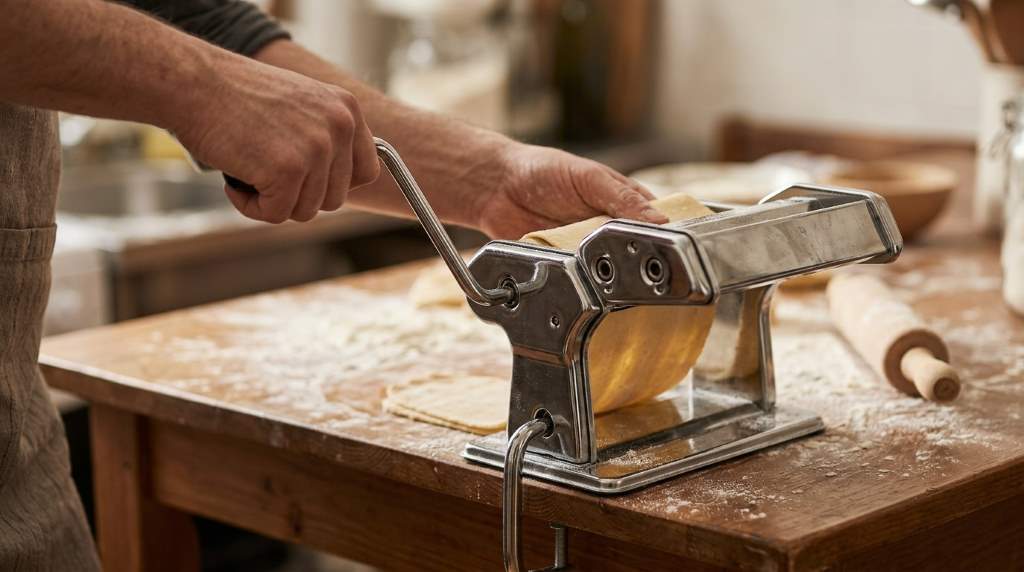
An electric pasta maker typically uses a motor to drive rollers or perform other pasta-making tasks. Sailnovo instead transfers your hand movement directly through the crank mechanism. Consequently, your speed, pressure, and rhythm influence the working pace.
Manual Sailnovo Vs Electric Pasta Makers
The biggest difference appears during repeated passes, especially when preparing pasta for several people. Sailnovo requires you to rotate the crank while feeding dough through the rollers. Electric machines generally automate that repetitive movement, reducing physical effort.
| Feature | Sailnovo Manual | Typical Electric Model |
|---|---|---|
| Power | Hand crank | Motor driven |
| Electricity | Not required | Required |
| User control | Very high | More automated |
| Physical effort | Moderate | Lower |
| Setup | Clamp and crank | Countertop and power connection |
| Noise | Generally quiet | Motor noise varies |
| Storage | Compact | Often larger |
| Power dependency | None | Electrical outlet needed |
Where Manual Operation Wins
Manual operation gives you direct control over feeding speed and dough handling. It also eliminates motors, power cords, and electrical components from the countertop. As a result, Sailnovo works well when portability and simplicity matter.
It also creates a more interactive cooking process for families and hobbyists. You can slow the crank whenever dough needs repositioning or extra flour. That control becomes especially useful while learning proper dough consistency.
Where Electric Operation Wins
Electric machines become attractive when you make large batches frequently. A motor reduces repetitive cranking and can make longer pasta sessions less tiring. Therefore, frequent meal preparation may justify paying more for automation.
Electric models can also suit users with limited hand strength or repetitive-motion concerns. However, they add electrical components, cords, and another potential failure point. Their larger footprint may also complicate storage in compact kitchens.
Sailnovo Features That Matter In Real Use
The Sailnovo earns attention through useful mechanical features rather than electronic convenience. Its nine thickness settings allow gradual adjustment from relatively thick sheets toward very thin pasta. The exact range varies slightly between Sailnovo listings and model versions.
Most current specifications place the range around 0.3 or 0.5 millimeters through approximately 3 millimeters. That flexibility supports pasta sheets, noodles, dumpling skins, and several traditional preparations. Still, recipe results depend heavily on dough hydration and preparation.
Nine Thickness Settings
The adjustment dial lets you progressively reduce dough thickness instead of forcing one dramatic change. Start with a wider setting, then move gradually toward your desired final thickness. This approach helps create smoother, more consistent sheets.
Beginners should avoid rushing through the settings. Instead, make several passes while checking the dough after each adjustment. That simple habit reduces tearing and produces more predictable results.
Two Cutting Widths
The integrated cutters provide two common noodle widths, although specifications vary between Sailnovo versions. Some listings identify approximately 2 and 6.25 millimeters, while others list narrower alternatives. Always verify the exact cutter dimensions for your model before purchasing.
Despite those variations, the practical advantage remains straightforward. You can roll sheets and cut noodles without buying another dedicated cutter. That makes the 2-in-1 format particularly useful for space-conscious cooks.
Food-Contact Construction
Sailnovo models commonly combine stainless steel and aluminum components within the pasta-making assembly. The construction feels more substantial than lightweight plastic alternatives. However, proper maintenance remains essential for preserving moving parts and cutting surfaces.
The manufacturer instructions recommend dry cleaning rather than routine water washing. Flour and dough residue should come away with a soft brush or dry cloth. This maintenance requirement matters when comparing convenience with dishwasher-friendly electric alternatives.
Using Sailnovo For Better Pasta Results
The machine cannot compensate for poorly prepared dough. A firm, smooth dough generally feeds through the rollers more cleanly than wet or sticky dough. Therefore, spend more attention on dough consistency than on aggressive machine adjustments.
Step 1: Secure The Machine
Attach the supplied clamp to a stable countertop or table before starting. The manual specifies a suitable surface thickness of roughly 1.4 to 2.7 inches. Tighten the clamp firmly so the machine remains steady during cranking.
A loose machine creates unnecessary movement and makes feeding dough harder. Consequently, check the clamp before every session. Stability improves both safety and the consistency of your pasta sheets.
Step 2: Condition The Dough
Divide the dough into manageable portions before feeding it through the rollers. Lightly flour the dough when necessary, but avoid excessive flour that can affect texture. The dough should feel firm enough to pass through without sticking.
Then flatten the portion slightly by hand before inserting it into the rollers. This small preparation step reduces strain on the mechanism. It also helps the first pass produce a more manageable sheet.
Step 3: Start Thick And Reduce Gradually
Begin with the widest roller setting rather than immediately choosing a thin setting. Pass the dough through several times until the sheet becomes smooth and uniform. Next, reduce the thickness progressively toward your recipe target.
Do not skip several settings simply to save time. Rapid reductions can create uneven edges, tearing, or difficult feeding. A controlled progression usually produces better results with less frustration.
Step 4: Cut Immediately After Rolling
Once the sheet reaches the desired thickness, lightly dust it before cutting. Then guide the sheet through the selected cutter using steady crank movements. Catch the noodles carefully and separate them before they stick together.
Fresh noodles can clump quickly when moisture remains on their surface. A light flour coating helps prevent that problem. For longer storage, arrange the noodles loosely before drying or refrigerating them.
Cleaning, Storage, And Long-Term Care
Cleaning represents one of Sailnovo’s less convenient characteristics. The machine should generally receive dry cleaning instead of routine water exposure. Flour residue can collect around rollers and cutters if you postpone maintenance.
Use a soft brush to remove loose flour after each session. For stubborn dough fragments, a wooden toothpick can reach narrow gaps carefully. Never force sharp objects against delicate surfaces or cutting components.
Why You Should Avoid The Dishwasher
Most Sailnovo specifications identify the machine as unsuitable for dishwasher cleaning. Water exposure can encourage corrosion or affect mechanical components over time. Therefore, dry maintenance remains the safer routine.
After cleaning, store the machine somewhere dry and protected from excessive humidity. Keep the crank and removable components together to simplify your next setup. A small storage container can prevent misplaced accessories.
Storage Matters More Than You Might Expect
The machine occupies less space than many fully automated appliances. Still, you need enough clearance for the clamp and crank during operation. Good storage planning prevents the machine from becoming an inconvenient countertop fixture.
If kitchen storage creates your main concern, kitchen storage ideas can help organize appliances more efficiently. A dedicated cabinet section keeps the machine accessible without consuming daily counter space.
Who Should Buy The Sailnovo?
Sailnovo makes the most sense for cooks who enjoy controlling the pasta-making process. It offers useful thickness adjustment without requiring electricity or complicated controls. Furthermore, its roller-and-cutter design covers the core tasks most home cooks need.
- Choose Sailnovo if: You make pasta occasionally or regularly in moderate quantities.
- Choose Sailnovo if: You prefer hands-on cooking and direct control.
- Choose Sailnovo if: You need a compact roller-and-cutter combination.
- Choose Sailnovo if: You want pasta making without electrical dependence.
- Choose another option if: You dislike repetitive hand cranking.
- Choose another option if: You regularly prepare very large pasta batches.
- Choose another option if: You strongly prefer dishwasher-friendly equipment.
Best For Beginners
Beginners can learn the fundamentals without navigating complex electronic controls. The simple mechanism makes each stage visible, from dough feeding to sheet thickness. That transparency helps users understand how dough responds to pressure and adjustment.
However, beginners should expect a short learning curve. Dough hydration, flour dusting, and gradual thickness changes all affect performance. Once those variables become familiar, the machine becomes considerably easier to use.
Best For Frequent Pasta Makers
Frequent cooks should consider how much physical effort each batch requires. One small batch may feel enjoyable, while several batches can make constant cranking tiring. Therefore, high-volume users may benefit more from motorized assistance.
Still, experienced cooks who value mechanical reliability may prefer Sailnovo. Fewer electronic components mean fewer electrical controls to manage or troubleshoot. The better choice ultimately depends on whether you prioritize automation or hands-on control.
Is Sailnovo Better Than An Electric Pasta Maker?
Neither design wins universally because each solves a different kitchen problem. Sailnovo prioritizes simplicity, control, portability, and electricity-free operation. Electric models prioritize convenience, speed, and reduced physical effort.
For occasional homemade pasta, Sailnovo can deliver strong practical value. For frequent large-batch cooking, an electric machine may justify its greater complexity. Before buying, consider your batch size, available storage, cooking frequency, and tolerance for manual work.
Environmental considerations can also influence the decision. A manual machine does not consume electricity while you roll or cut pasta. Readers exploring lower-impact pasta preparation can also review sustainable pasta making for broader ideas.
Pros And Cons At A Glance
| Pros | Cons |
|---|---|
| No electricity required | Requires continuous hand cranking |
| Roller and cutter in one unit | Not ideal for very large batches |
| Multiple thickness settings | Cleaning requires dry maintenance |
| Compact countertop footprint | Clamp needs a suitable surface |
| Direct control over pasta thickness | Specifications vary across model versions |
| Simple mechanical operation | Less convenient than motorized operation |
Final Verdict: Is Sailnovo Worth Buying?
Yes, Sailnovo is worth considering if you want an affordable, hands-on pasta roller and cutter. Its strongest advantage comes from combining practical adjustment with simple manual operation. The machine does not pretend to replace the convenience of an electric motor.
Instead, Sailnovo targets cooks who enjoy making pasta rather than merely automating it. Its nine-setting adjustment, dual cutting function, compact design, and electricity-free operation create a balanced package. Just confirm your exact model’s specifications before ordering because Sailnovo has released versions with different settings.
If you make modest batches and enjoy the process, choose Sailnovo with confidence after checking the clamp fit. If speed and effortless production matter most, compare electric machines instead. Choose the machine that matches how you actually cook, not simply the feature list.
Frequently Asked Questions
Is the Sailnovo 2-in-1 pasta maker electric?
No, the Sailnovo 2-in-1 pasta maker uses a manual hand crank rather than an electric motor.
What does 2-in-1 mean on the Sailnovo pasta maker?
It means the machine combines dough rolling and noodle cutting functions in one countertop unit.
How many thickness settings does Sailnovo have?
Many current Sailnovo versions provide nine thickness settings, although specifications vary between models.
Can you wash the Sailnovo pasta maker with water?
No, dry brushing and wiping are generally recommended instead of water washing or dishwasher cleaning.
Is Sailnovo good for beginners?
Yes, beginners can learn it quickly, provided they prepare firm dough and reduce thickness gradually.