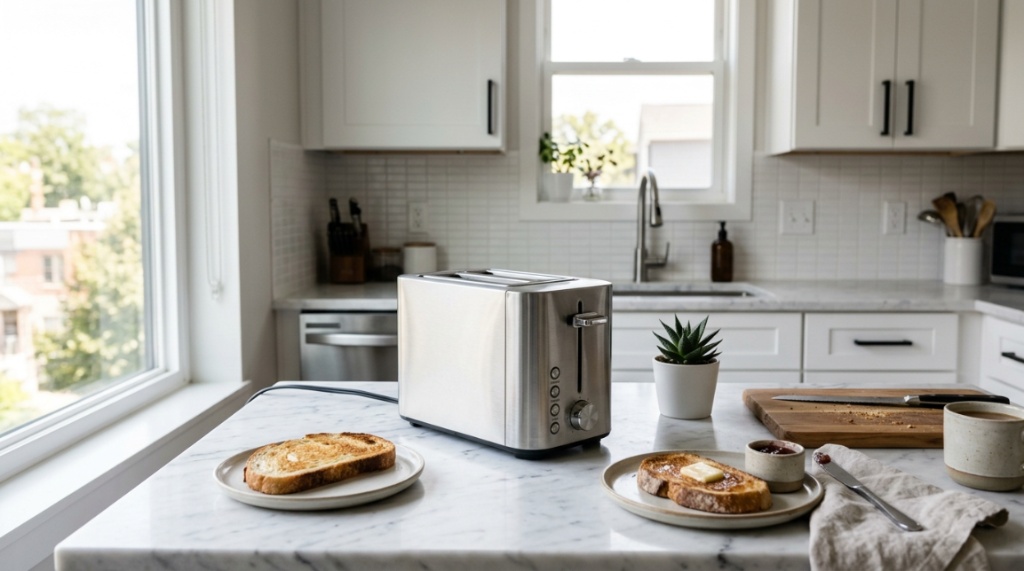
Counter space in a small kitchen is prime real estate. You know the struggle: you’re trying to fit a coffee maker, a microwave, and a toaster, but your countertops are only a few square feet. Standard toasters often feel bulky, and they push your workspace to the brink. You just want toast without having to rearrange your entire kitchen every morning. The solution isn’t to give up toast—it’s to choose a toaster designed specifically for tight spaces. In this guide, we’ll walk through exactly what makes a toaster space-efficient, the features that actually matter, and how to pick the best space saving toaster for small kitchens without sacrificing performance.
Key Takeaways
- Measure your counter depth first: A “slim” toaster often means it is narrow in width, but you must also check the depth and height to ensure it fits under upper cabinets.
- Prioritize a 2-slice design: For most small kitchens, a 2-slice toaster with a vertical slot orientation offers the smallest footprint while handling daily needs efficiently.
- Look for a cord wrap and cool-touch exterior: These features keep the counter organized and allow you to tuck the toaster against a wall safely.
- Consider integrated warming racks: A removable rack adds versatility without increasing the base footprint, which is ideal for reheating pastries or bagels.
- Don’t ignore the crumb tray: An accessible, dishwasher-safe crumb tray is essential for easy maintenance in confined spaces where cleaning is harder.
What Defines a “Space Saving” Toaster?
When manufacturers label a toaster “space saving,” they usually refer to one of two things: the physical footprint (width and depth) or the design orientation. The most common space savers are the “slim” models, which are typically 2-slice toasters designed to be narrower than standard 4-slice models. However, you’ll also encounter “upright” or “vertical” toasters that stand tall but occupy a smaller square footage on the counter,
Looking for more budget-friendly upgrades? Explore Three budget-friendly ways to refresh your kitchen to completely revamp your cooking space without overspending.
It is crucial to look at the actual dimensions rather than relying on the marketing label. A toaster that is labeled “slim” might still be deep, which can be a problem if your counter is shallow. A standard toaster generally measures about 12 inches wide, 8 inches deep, and 7 inches tall. A true slim model will cut that width down to under 10 inches, sometimes reaching as low as 6 inches for single-slice options. For most people, the depth (front to back) is the most critical measurement, as this is often the limiting factor on narrow countertops between the backsplash and the edge.
The Two Main Types: Slim vs. Vertical
Slim (Horizontal): These are the classic elongated toasters but with a reduced length. They are excellent for fitting between a sink and a stove. Because the slots are horizontal, they are usually long enough to accommodate a standard slice of bread without sticking out.
Vertical (Upright): These toasters have a much smaller footprint because the bread is inserted vertically (like a slot in a vending machine). They are often taller but take up only about 6×6 inches of counter space. They are perfect for very tight corners but may not fit smaller bread slices easily, and they sometimes cook less evenly due to the heat rising in a taller column.
How to Choose the Right Size and Capacity
Start by matching the toaster size to your actual consumption. If you live alone or with one other person, a 2-slice model is almost always the right choice. Opting for a 4-slice “space saver” is often a trap—while they may be narrower than two separate toasters, they are still wide and heavy. A 2-slice toaster is generally lighter, easier to move, and consumes less electricity.
You should also consider the type of bread you eat. If you prefer thick-cut artisan bread or bagels, you need a toaster with deeper slots. Some slim toasters are too shallow, meaning you have to push the bread down only slightly, which results in the top half not being toasted. Look for a toaster with a high-lift mechanism so you can easily remove smaller items like English muffins without burning your fingers.
Material and Weight Considerations
In a small kitchen, you might need to store your toaster in a cabinet when it is not in use. If this is your plan, weight is a critical factor. Plastic-bodied toasters are significantly lighter (often under 2 pounds) but feel less durable. A stainless steel or metal toaster looks higher-end and dissipates heat better, but it can weigh 4-5 pounds, making it a hassle to haul out every morning. Weigh the aesthetics against the practicality of lifting it frequently.
Essential Features for Compact Living
Just because a toaster is small doesn’t mean it has to be basic. Several features make a compact toaster vastly more user-friendly and worth the investment. When space is tight, every function must earn its place.
Bagel Mode and Defrost Settings
These are not just buzzwords. A bagel setting toasts only the cut side of the bagel while leaving the outside soft. In a standard toaster, a bagel often comes out either raw on the inside or burnt on the outside. Similarly, a defrost setting uses lower heat to thaw and toast frozen bread in one cycle, which is incredibly useful for those who buy in bulk and freeze bread to save space.
Auto-Centering and Even Toasting
One of the biggest frustrations with slim toasters is uneven browning. In a narrow toaster, the bread sits closer to the heating elements on the sides. This is fine if the bread is the exact size of the slot, but if it is smaller (like a bagel thin), you get hot spots. An auto-centering feature adjusts the wires to hold the bread in the exact center of the toaster, ensuring the heat is distributed evenly. This is a feature usually found on higher-end models, but it is worth searching for because it significantly improves results.
Cord Management
On a crowded countertop, a dangling cord is a hazard and an eyesore. A proper cord wrap on the bottom of the toaster allows you to shorten the cord to just the length you need. This prevents the cord from pushing other appliances out of place or dropping down into the workspace. Some slimmer models also offer a side cord exit, which allows you to plug the toaster in without pulling it forward from the wall.
What to Look For in a Slim Toaster (Buying Guide)
When you are ready to make a purchase, focus on these specific physical and functional attributes to avoid a return:
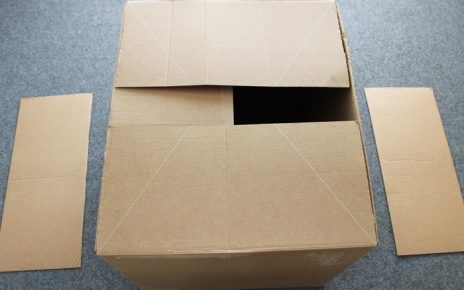
- Footprint Dimensions (LxWxH): Write these down and physically cut out a piece of cardboard that size. Place it on your counter to see how it fits.
- Slot Length: Ensure the slot is long enough for your bread. A cheap toaster may have a slot that is only 5 inches long, which will not fit standard 7-inch bread.
- Heat Control: Look for a numbered dial (1-6) rather than just “Light/Dark” buttons. This gives you more control to adjust for different types of bread.
- Reheat Function: Some models require you to turn the dial to a specific “Reheat” setting, while others have a separate button. A dedicated button is usually more accurate.
- Pop-up Height: A “high lift” feature is not just for convenience; it ensures you can grab small items without burning your fingertips.
- Simplified Cleaning: A removable crumb tray is almost standard now, but check if it is dishwasher safe. You should also look for a smooth exterior that you can wipe down easily, as textured plastic tends to attract grease and dust.
Potential Drawbacks of Slim Toasters
It is important to understand the limits before you buy. Many slim toasters cannot fit multi-layered items like thick bagels or large sourdough slices. They also often lack a “cancel” button, which is a safety feature that allows you to stop the toasting cycle instantly if you smell burning. The lower wattage (usually around 700-900 watts compared to 1200 in larger models) means they can be slightly slower to toast, taking an extra 30-60 seconds per cycle. If you are toasting for multiple people in a hurry, this could be an issue.
The “Shallow” Option: Low-Profile Toasters
If your kitchen lacks height clearance under shelves, a low-profile model might be the answer. These toasters are shorter (around 5 inches tall) and wider to compensate. They are useful if you have mounting shelves directly above your counter or if you want to store the toaster in a lower cabinet. However, because of their shape, they often require you to insert bread horizontally, which takes up more width on the counter than you might expect.
Space Saving Alternatives to Traditional Toasters
If you are still struggling to find a toaster that fits, consider alternative cooking appliances that can serve the same purpose with even greater versatility. While the toaster is the primary focus, these are worth comparing:
- Toaster Ovens (Large Footprint): These do everything a toaster does and much more, but they are the biggest option in this category. Only choose this if you need to replace both a toaster and a small oven.
- Air Fryers with Toast Function: Many modern air fryers can toast bread, but they are often bulky and shallow. They are not a direct replacement for a traditional toaster in terms of convenience.
- Induction Toasters: These use magnets to heat the pan inside them. They are extremely fast and thin but are a specialty item that is harder to find.
Maintenance Tips for Compact Toasters
Small kitchens often have poor ventilation. If you live in a studio or a galley kitchen, grease and cooking odors can settle on your toaster. To keep it working well:
- Unplug it daily: This is good for safety and saves a tiny amount of standby energy.
- Empty the crumb tray weekly: Crumbs are a fire hazard. If the tray is full and the crumbs touch the heating coils, you will get a burning smell.
- Wipe the interior: Once a month, turn the toaster upside down over a trash can and gently shake out any trapped crumbs. Do not use water inside.
- Check the cord: In tight spaces, cords can get pinched against the wall or other appliances. Regularly check for fraying.
Frequently Asked Questions
Are 2-slice toasters more energy-efficient than 4-slice toasters?
Yes. A 2-slice toaster generally has a lower wattage (around 800-900 watts) compared to a 4-slice model (around 1,500-1,800 watts). Because a 2-slice toaster heats a smaller cavity, it requires less energy to bring the coils up to temperature and will toast your bread faster relative to the space size, saving a small amount of electricity per use.
Can I toast bagels in a slim space saving toaster?
You can, but you must check the slot depth. Most slim toasters are designed for standard bread. If your toaster has a “Bagel” setting, it can handle pre-sliced bagels. However, very thick, dense bagels or artisan bread may stick out of the top, causing uneven toasting or burning where the bread touches the top metal guard.
How long does a compact toaster last compared to a standard one?
There is no inherent difference in lifespan based on size. The critical factor is the quality of the heating elements and the spring mechanism. A compact toaster with a metal internal chassis and a strong spring will last as long as a standard one, typically 5-7 years with daily use. The main issue with cheaper models is the plastic gears that control the levers wearing out.
Is it better to store a toaster vertically if I have very little space?
Yes. Vertical toasters (where the bread is dropped down into a slot at the top) have the smallest counter footprint available, often comparable to a coffee mug. They are excellent for studios. The drawback is that they are tall, so they may not fit under upper cabinets, and some users find them awkward to load because you have to look down from above to align the bread.
What is the best way to measure my counter space for a new toaster?
Use a tape measure to determine the depth of your counter (from the wall to the edge) and the available width between other appliances. Measure the clearance height to any upper cabinets. Subtract at least 2 inches from the depth and height to allow for proper airflow and to prevent the plastic casing from overheating against walls.
Conclusion
Finding the best space saving toaster for small kitchens comes down to balancing width, depth, and capacity with your daily needs. You don’t need to sacrifice toast quality to reclaim your counter space. Start by looking for a 2-slice model with a narrow footprint and a high-lift lever, and ensure it offers the basic functions you use, like a bagel mode. Don’t forget to check the cord length and location, as these are the details that keep a compact kitchen functional. While there are many options on the market, remember to prioritize a model that fits your physical space constraints first, and then look at the bells and whistles. Measure your area, choose a model with reliable heating elements, and you will be ready to enjoy perfectly crispy toast without cluttering your kitchen again.