
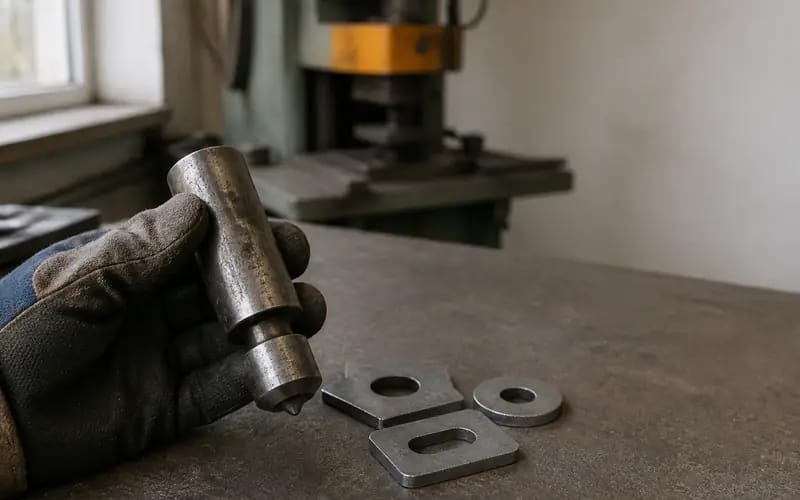
The Punching Dies on your Euromac Punching Machine don’t last forever and will at some point need to be replaced to prevent parts being damaged or the punch breaking whilst in use.
Check The Finished Parts First
Burring, slugs catching in the punch or tears in the sheared edge of parts all signal problems with the cutting edges of your die. In mild steel, where sharp clean shears are expected, start to look for die wear when you notice less than perfect edges being produced. It is likely that the die clearance has increased beyond the specified setting for the tooling.
Listen And Feel For Changes
At the time the tooling starts to change in shape of form of the wearing parts it generally makes some form of noticeable change to the sound and/or operation of the machine. It may start to sound different and even produce a “thud” as opposed to a crisp “snap” for example. Extra vibration through the frame of the machine would also indicate that something has changed in the tooling. By keeping your work equipment properly maintained you can swap over the worn tooling at a time of your choice to minimise production downtime in order to complete the required number of parts as fashioned before failure occurred.
Measure The Punch To Die Clearance
Measuring the clearance between punch and die (using a set of feeler gauges or callipers) will give a much better indication of whether or not the tooling is still within recommended limits. A typical clearance for most punching tooling is 10% of the material thickness, i.e.0.3mm for 3mm thick mild steel. A clearance that increases beyond this specified amount (typically doubling the original setting) will rapidly degrade edge quality.
Know The Difference Between Wear And Damage
Wear vs. Damage: These two are treated very differently. Wearing down a tool slowly over weeks and getting poorer results with every part is something you can plan to replace. However, a sudden occurrence of a small chip or hairline crack in a punch or die requires an immediate decision: pull the die now and risk possible additional expenses or fail it and risk possible damage to the tool holder or even the press. The safe use of punching and metalworking machinery in general needs to be treated as a set of strict rules which also define the speed of reaction in case of an incident.
Factor In What You’re Punching
Additionally, different materials vary dramatically in the amount of wear and tear that a punching die experiences. Mild steel and thin aluminium will see massive increases in life compared to punching thicker high tensile steel. For example, a 1mm aluminium punch may last tens of thousands of parts, whereas a 6mm high tensile steel punch would last only in the low thousands. In many high production environments, tracking the number of parts punched of different materials is a useful way of establishing the remaining life of a particular die.
Decide Between A Regrind And A Full Replacement
A regrind is cheaper than buying new and generally acceptable for a second regrind. However, a third regrind starts to eat away at the remaining length of the tool and the hard face of the tool. It is not cost effective to continue to regrind a tool that has started to wear in this way. As a user of Euromac Punching Machines, knowing when to replace the tooling is key to ensuring reliable operation of your machinery.
Order Replacement Tooling Before You Need It
While replacement parts for specific dies are not always stocked by machinery dealers, lead times for all tooling can vary greatly from a few days to several weeks, depending on supplier and quantity ordered. By having a basic set of the most frequently used shapes in the most frequently used sizes for particular materials, a workshop can avoid being held up for several days while a needed part is rush ordered in the middle of the night. (Punching force varies with the material’s properties, and materials people and engineering researchers can provide quantifiable data on this for specific materials – generally harder materials wear faster than softer ones.)
If you recognise the wear on your punching tools early enough, you can easily replace the few spare tools you keep in stock to avoid a production halt due to a broken tool.