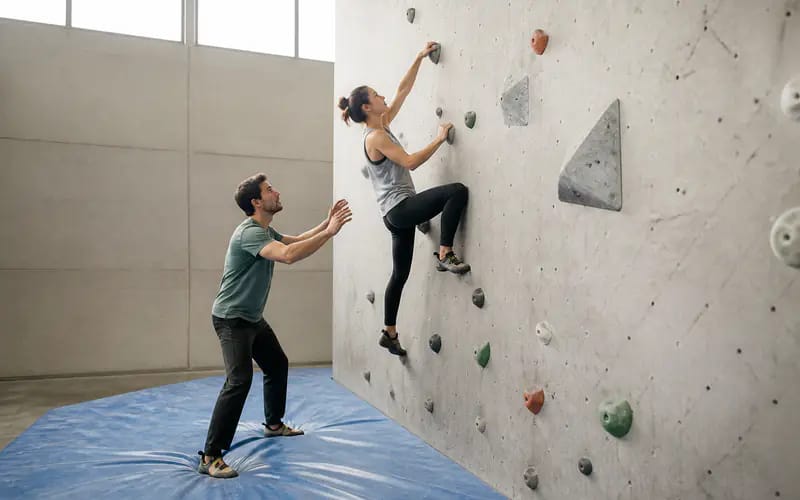
This is not a ‘catch’ in the manner of a fireman’s lift. Instead, you are guiding a fall such that the climber will land safely on their backside on the mat below. With practice, you will be able to do this successfully and not cause any harm to the climber.
What Spotting Actually Means
Catching a climber who falls is far too dangerous for both them and you. You will not be able to hold their weight and will most likely end up being pulled to the ground by them. Spotting for a climber who falls involves guiding their fall so that they land safely on their feet or bottom on the bouldering mat.
Where to Stand
Standing to the side of the climber, slightly behind them is the normal position for spotting. If a climber falls whilst you are standing underneath them then you will be put in danger of also falling and being seriously injured. Also if a climber falls past you then they are less likely to fall on top of you. As the climber ascends the wall then you will need to move to the side to keep up with them.
Hand and Arm Position
Keep your thumbs tucked into your palms and hold your hands up in front of the climber with your palms facing them and your fingers spread. Keep your arms slightly bent and don’t grip anything. Tucked thumbs are much better than sticking out a thumb as a climber falling awkwardly can catch it and badly injure it. Keeping your hands moving with the climber is also better than having them stationary.
Watch Hips and Shoulders, Not Hands
Most new spotters fixate on the climber’s hands and feet. However, a climber falls from the hips down and thus a good spotter is watching the climber’s shoulders and hips. This gives the new spotter an extra half second to react to a slip turning into a fall that needs to be caught.
Track Their Centre of Gravity
Also remember that as a climber traverses a boulder problem their weight will transfer from left to right and from lower to higher parts of their body. As a spotter you need to transfer your position to roughly below their centre of mass as they climb. Yes this can be tiring but if you are tired then you are doing it right. The biggest mistake of people spotting for others is to be standing in a static position hoping for the best as they fall.
Redirect, Don’t Restrain
If a climber does fall then you can use gentle pushes on their hips or shoulders to redirect their fall towards the middle of the mat. Remember to try and steer them away from other climbers, bags, water bottles etc. on the floor. Remember to always follow the British Mountaineering Council’s (BMC) safety guidance for indoor climbing and bouldering for fall management, and try to read as much about it as possible to better understand how to help people in a fall.
Agree the Spot Before Climbing
Talk to the climber before they set off for the problem. Ask if they want a spot, and where on the problem the main tricky or high moves are. Get them to say ‘climbing’ before they set off so you know they have noticed you there to spot. A good spotter starts spotting from the ground for the first move of a climb, not half way up. This simple act of communication is what separates good partners from bad.
Knowing When Spotting Isn’t Needed
The vast majority of bouldering problems do not need spotting. Most low traverses, bouldering areas with very good and deep padding, and short problems with the climber never being more than a meter or so off the ground do not need a spotter. The fall would be broken by the excellent mats and in many cases the ground beyond would be sufficient. It is best to reserve your attention for problems with genuine fall risk, for example, overhanging walls, very awkward topouts, and anything above your head.
Practising With Others
Practice these new skills with other climbers, who can show you how to best set up to watch for a fall. Then look for Bouldering Near Me to find a good wall with an open bouldering area where other experienced climbers will often be on hand to provide good spotting. Sports England’s site for finding local climbing and bouldering gyms and facilities is a good starting point, and in recent years the government’s initiatives to encourage participation in various sports have meant that more and more indoor climbing walls are being set up across the UK. Online UK climbing and bouldering forums and communities for regular climbers are also good places to ask for help and advice on various aspects of climbing and bouldering, including in-depth discussions on the spotting techniques and etiquette that are used at walls all over the country.
Spotting is a habit that can take some time to get used to, so don’t rely on a single article or guide to teach you. Go and watch other spotters at your local climbing wall, ask them questions about how they are spotting and most importantly of all don’t be afraid to admit that you don’t know something and need help!